

Table of Contents
- Graphic Golf Tees vs Plain Polo Shirts: The Short Answer
- Side-by-Side Comparison: Golf Tees vs Polos
- Golf Polo vs. Golf T-Shirt: Fabric, Fit, and Mobility
- Golf Course Dress Code: Where Each Shirt Works
- Casual Golf Outfits: Styling Tees and Polos by Occasion
- Graphic Design, Print Quality, and Longevity
- Care, Print Longevity, and Garment Lifespan
- How to Choose: A Decision Framework
- Frequently Asked Questions
Last Updated: October 6, 2026
Graphic Golf Tees vs Plain Polo Shirts: The Short Answer
Graphic golf tees vs polos comes down to one question: how much does the course care? At private clubs and many public courses, a collared shirt is the price of admission.
The verdict: at a private club or a course with a posted dress code, wear a polo. At a public course, par-3, range, or simulator, a graphic tee works.
Side-by-Side Comparison: Golf Tees vs Polos
Golf tees and polos split on four points: collar requirements, fabric, fit, and personality. A polo is safer for course access; a graphic tee wins on comfort and self-expression off the green.
| Factor | Graphic Golf Tee | Plain Polo Shirt |
|---|---|---|
| Course access | Casual and public courses only | Nearly all courses, including private |
| Fabric | Usually cotton or cotton blend | Cotton blend or performance knit |
| Collar | None | Ribbed or knit collar with placket |
| Fit | Relaxed, straight cut | Regular to tapered |
| Personality | Bold graphics, humor, color | Clean, understated, logo-friendly |
| Best for | Range, par-3, simulator, post-round | Tee times, clubhouse, tournaments |
Fit, Fabric, and Comfort Compared
Fit is where they diverge fastest. Graphic tees run relaxed with a straight hem, comfortable, but sloppy tucked in. Polos sit closer with a defined shoulder line: sharper on the course, more restrictive on a full swing.

Fabric matters just as much. Heavier cotton blends hold their shape and resist sweat-through in summer heat. Lighter performance knits breathe better but wrinkle easily. For most golfers, a midweight cotton blend is the sweet spot.
Golf Polo vs. Golf T-Shirt: Fabric, Fit, and Mobility
A golf polo and a golf T-shirt differ most in collar structure and shoulder cut, which decide how freely you swing. The polo's placket and collar keep the neckline stable; the tee's crew neck moves with you but offers less structure.
Mobility comes down to three things:
- Shoulder seam placement. Drop shoulders (common on tees) allow more arm rotation; set-in sleeves (common on polos) look cleaner but restrict slightly.
- Fabric weight. Heavier knits drape better and resist clinging after a swing.
- Stretch. Performance blends with spandex move with the body; 100% cotton does not.
For a warm-weather round, a midweight cotton-blend polo or a well-made graphic tee both work. The difference is polish, not performance.
Golf Course Dress Code: Where Each Shirt Works
Most golf course dress codes require a collared shirt, ruling out the graphic tee at private clubs and many public courses. That rule decides the question more often than fabric or fit, but the exceptions are where readers get burned.
Dress codes are set course by course, not by a national governing body. The USGA and state associations publish rules of play, but they don't dictate what you wear to a Saturday tee time.
How to Read a Course's Dress Code Before You Book
Courses publish dress codes in four places, each enforced differently:
- The booking page or tee-time confirmation email. This is the most current source and usually the most specific.
- A dedicated "Course Policies" or "Guest Information" page. Often the most detailed, and where collared-shirt language typically lives.
- The pro shop phone line. The fastest way to confirm a gray-area case, like a graphic tee with a small chest logo.
If the posted language says "collared shirt required" or "no t-shirts," treat it as final. If it says "proper golf attire" without specifics, call, that phrase is vague and enforced at staff discretion.
Where Each Shirt Typically Works
- Private clubs and country clubs: Polo required. Collar and placket are non-negotiable, and many also prohibit denim, cargo shorts, and athletic sneakers.
- Upscale public and resort courses: Usually collared shirts required. Some allow mock-neck or blade-collar performance tops, which sit between a polo and a tee.
- Standard public courses and munis: Policies vary widely. Many allow tees, some require collars only on weekends or during league play, and a few enforce collars year-round.
A common mistake is assuming "public course" means "no rules." Public courses set their own policies and can turn you away at check-in. Call ahead or check the website before you show up in a tee. The USGA's guidance on course policies is a good starting point for understanding how individual clubs set their own standards.
The Gray Areas That Trip People Up
A few situations sit between the two:
- Graphic tees with a small chest logo. Some courses treat a small logo like a polo logo and let it pass; others treat any print as a t-shirt. Ask before you assume.
- Mock-neck and blade-collar tops. These have no traditional collar but are accepted at many courses that require a collar. They are the closest thing to a loophole in the rule.
- Collared graphic pieces. A polo or collared sweatshirt with a printed design satisfies the collar requirement and carries the personality of a graphic tee. This is the safest way to wear a joke on a course with a rule sheet.
Showing up in a graphic tee at a private club or a course with a posted collared-shirt policy can get you turned away at check-in, no refund. Always confirm the dress code before you book.

Dress codes are set course by course. The posted policy on the booking page or the pro shop phone line is the only source that matters. When in doubt, wear a collar.
Casual Golf Outfits: Styling Tees and Polos by Occasion
Casual golf outfits work best when the shirt matches the setting. A graphic tee at simulator night looks intentional; the same tee at a member-guest tournament looks like a mistake.
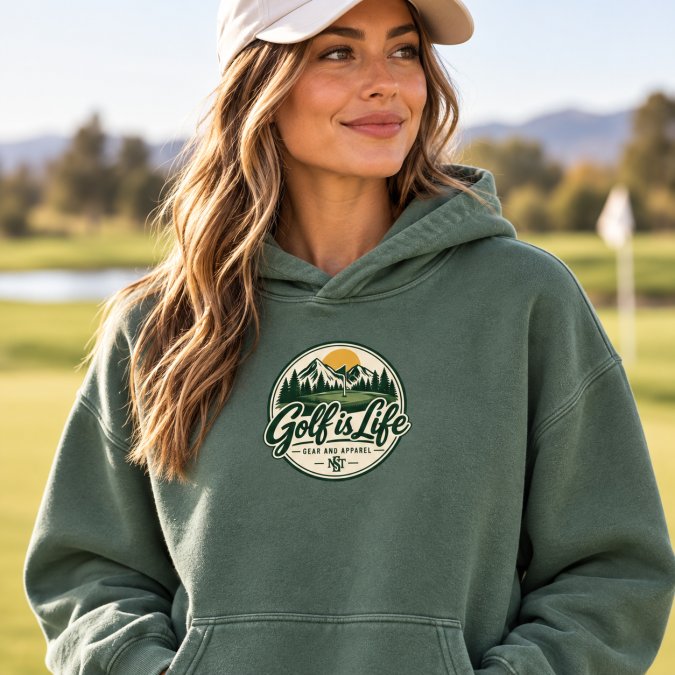
Match the shirt to the occasion:
- Range session or simulator: Graphic tee, joggers or shorts, sneakers.
- Par-3 or pitch-and-putt: Graphic tee or casual polo, golf shorts.
- Standard public course: Polo, unless the course explicitly allows tees.
If you want the humor without the dress-code risk, a collared layer solves it. Our My Safe Word is Fore - Unisex Color Block Polo Shirt puts the joke on a proper golf polo, so you get personality and collar in one piece. For cooler mornings, the Golf is Life - Unisex Oversized Collared Sweatshirt does the same with more warmth.
Graphic Design, Print Quality, and Longevity
Print quality decides whether a graphic tee still looks sharp after twenty washes or turns into a cracked mess by summer's end. Design matters too: how big the graphic is, where it sits, and what it signals about formality. A plain polo carries no graphic, so a graphic tee's personality lives or dies on these choices.
My Safe Word is Fore - Unisex Color Block Polo Shirt →
Print Methods and How They Age
The two methods you'll see most on graphic golf tees are screen printing and heat transfer (DTG, or direct-to-garment). They age differently.
The thicker the fabric, the better any print holds up.
Design Choices That Change How Formal the Shirt Reads
A graphic tee and a plain polo sit at different points on a formality scale, and the graphic moves that needle.
- Print size. A small chest logo reads closer to a polo. A full-front print reads clearly casual. A large back print reads casual and is often hidden under a layer anyway.
- Print placement. Centered high on the chest reads as a statement. Low on the torso reads as an afterthought. Off-center or sleeve prints read as streetwear, which is a different signal entirely.
- Color count. One- or two-color prints read more restrained and pair more easily with golf shorts and a cap. Full-color, high-contrast prints read louder and are harder to match.
Print placement and size matter as much as method. Check product photos before you buy, and look for a shot on a model rather than flat-laid, since the print sits differently on a body.
How Graphics Age Versus How Polos Age
A plain polo has no print to fail, so its lifespan is limited by fabric and collar structure. A graphic tee's lifespan is limited by whichever fails first: print or fabric.
Wash graphic tees inside out in cold water and hang them to dry. The same habit extends the life of a polo collar.
Print method, print size, and print placement together decide how long a graphic tee lasts and how formal it reads. A small, restrained print on a midweight cotton blend is the closest a graphic tee gets to polo energy.
Care, Print Longevity, and Garment Lifespan
How you care for a graphic tee determines whether it lasts one season or five. The rule: cold water, inside out, no dryer heat on the print.
Care basics that extend lifespan:
- Machine wash cold on a gentle cycle.
- Turn the shirt inside out before washing to protect the print.
- Skip bleach and fabric softener, both break down cotton fibers and print adhesion.
Polos follow the same rules, plus keep the collar flat while drying to prevent curling. A correctly washed cotton-blend polo holds its shape for years; a carelessly treated tee loses its print in months.
How to Choose: A Decision Framework
Choosing between a graphic golf tee and a plain polo comes down to three questions: where you're playing, what the dress code says, and how much you want to say with your shirt.
Run through this before you buy:
- Does the course have a posted dress code? If yes and it requires a collar, buy a polo.
- Is this for a range, simulator, or casual round? A graphic tee works.
- Do you want the humor visible on the course, or only off it? A collared graphic piece covers both.
For most golfers who want personality and course access, the answer is one of each: a graphic tee for casual rounds and range days, and a collared graphic piece for anything with a rule sheet. The Golf is life - Quarter Zip Sweatshirt rounds out the rotation for cool mornings.

Frequently Asked Questions
What is the difference between a t-shirt and a golf shirt?
A golf shirt, or polo, has a collar and placket, usually two to three buttons, and a hem cut to stay tucked or worn out. A t-shirt lacks a collar and typically uses lighter cotton or a cotton blend. Golf polos often use performance fabric for moisture-wicking, while tees focus on softness. The collar is the biggest visual difference, and it is also what most dress codes care about.
Are graphic T-shirts allowed on golf courses?
It depends on the course. Private clubs and many resort courses require a collared shirt, which rules out tees. Municipal and public courses are often more relaxed, especially for twilight rounds or practice sessions. Always check the course's posted dress code or call the pro shop before you play. A graphic golf tee might be fine at one course and turned away at another.
Are golf polos more comfortable than T-shirts?
Not automatically. A midweight cotton blend polo like the My Safe Word is Fore polo (65% cotton, 35% polyester, 240 gsm) feels substantial and breathable for spring and summer rounds. A lightweight performance tee can feel cooler in heat. Comfort depends on fabric weight, breathability, and fit more than on whether the shirt has a collar. Try both in similar conditions to see which you prefer.
When should you wear a polo instead of a graphic tee?
Wear a polo at private clubs, tournament play, business-adjacent outings, and any course with a collared-shirt rule. Choose a graphic tee for casual rounds at public courses, range sessions, post-round drinks, and everyday wear. If you are unsure, a collared polo is the safer pick. You can always change into a graphic tee after the round.
What should you wear to a casual golf outing?
For a casual outing, start with a collared polo or a clean graphic tee, depending on the venue. Pair it with golf shorts or pants, a belt, and golf shoes or sneakers. A quarter-zip layer like the Golf is Life Quarter Zip Sweatshirt ($39.96) works well for cool mornings. Check the course dress code first, then build your outfit around comfort and mobility.
Here's the challenge: most golfers either play it safe with a plain polo and lose the personality, or wear a graphic tee to the wrong course and get turned away. No Safe Tee's solves both with bold graphic designs built onto proper golf-ready pieces, including collared polos, oversized collared sweatshirts, and quarter-zip layers that hold up wash after wash. Get started with No Safe Tee's and wear exactly what you're thinking, on the course and off.